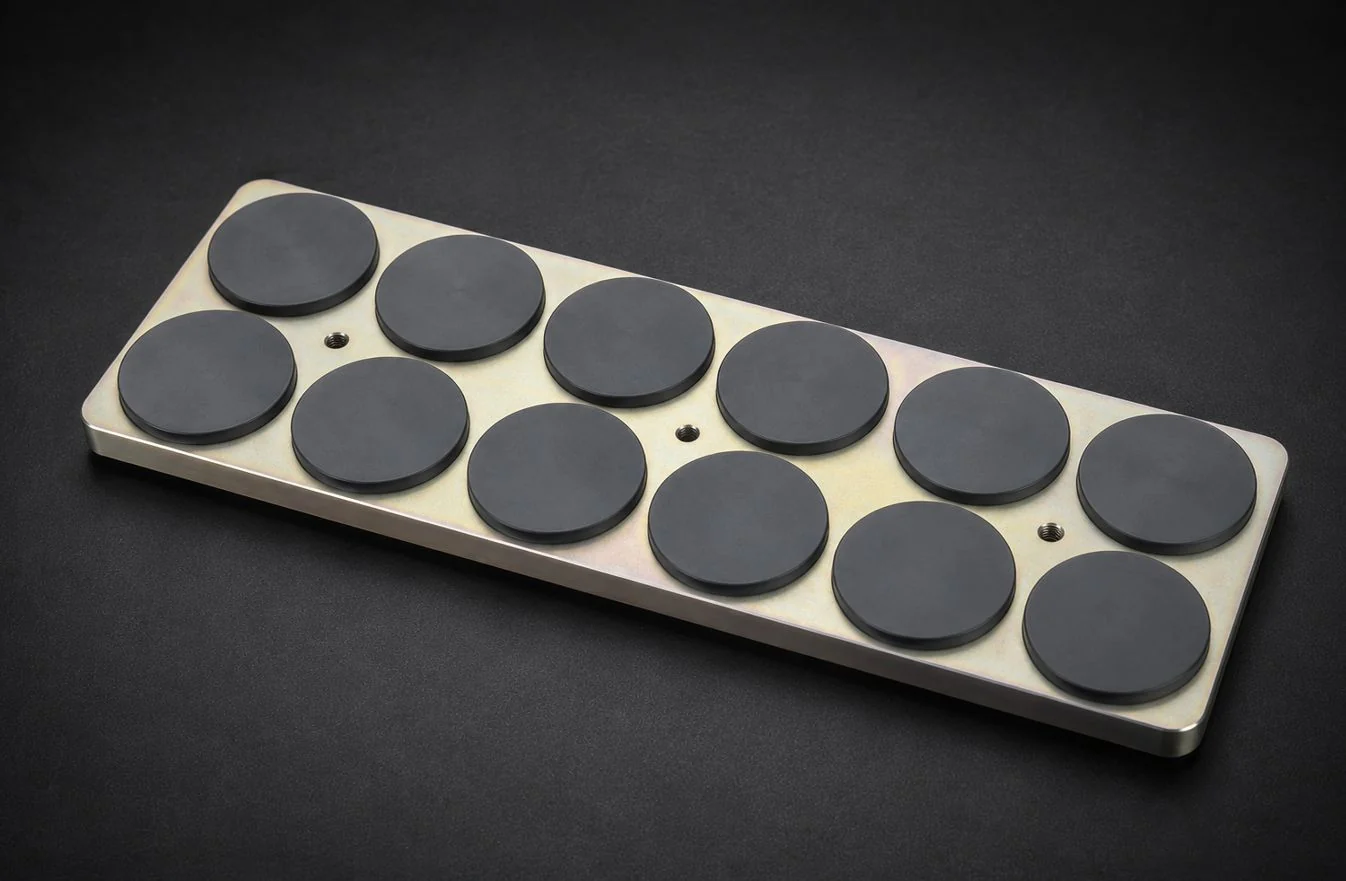
FTL-207 composite friction material for wind turbine yaw-brake applications
FTL-207 is an FTL-developed composite friction material intended for wind turbine yaw-brake applications.
FTL reviews the yaw-brake duty, existing component, operating environment and required evidence before confirming whether FTL-207 is an appropriate material route.
Where technical fit is established, FTL can connect the material with component engineering, precision machining, bonding, finishing, testing, inspection and repeat manufacture through one accountable production chain in North Wales.
FTL-207 is an engineered composite material route, not a universally interchangeable catalogue item.
FTL-207 technical summary
The fields below are published. Tell FTL what the material is for and the full specification follows, including the coefficient values, material form and supply forms not shown here.
| Technical field | Value |
|---|---|
| 01Product reference | FTL-207 |
| 02Manufacturer | Friction Technology Ltd |
| 03Intended application | Wind turbine yaw-brake applications |
| 04Material family | Carbon composite friction material, bonded to an optional glass-fibre reinforced supporting layer |
| 05Coefficient classification | Medium coefficient |
| 06Friction coefficient | 0.30 to 0.40 |
| 07Density (carbon composite) | 1.35 g/cm³ |
| 08Max. dynamic load | 25 N/mm² |
| 09Max. static load | 50 N/mm² |
| 10Wear rate | 10 mm³/kWh |
| 11Max. sliding velocity | 15 mm/s |
| 12Temperature range | −40 to 140 °C |
| 13Mating surface | Fine-grained pearlitic cast iron or cold rolled steel, Brinell hardness >160HB, counter-surface roughness <3.2µm |
| 14Technical data sheet | FTL207 data sheet (PDF) |
Technical disclaimer: values published on this page apply only within their stated conditions. Material behaviour in a complete yaw-brake system can also be influenced by component geometry, pressure, speed, temperature, contamination, mating surface, braking or holding duty, installation and wider system conditions.
When FTL-207 may be assessed for a yaw-brake programme
FTL-207 should be assessed against the individual yaw-brake application rather than selected from the product name alone.
A new yaw-brake programme needs a defined material route
The system function and broad application requirements are known, but the friction material, component form or repeatable manufacturing route still needs to be established. FTL can assess FTL-207 alongside the application requirements and agree the prototype, test and validation work needed before production.
New Programme Support →An existing yaw-brake material is not performing as required
The engineering team is observing inconsistent braking or holding behaviour, excessive or unpredictable wear, thermal-performance concerns, or variation between components or production batches. FTL can review whether FTL-207 should form part of a comparative material and component investigation.
Performance Optimisation →The original material or supply route is no longer available
An existing yaw-brake component must remain supportable, but the original material, drawing, supplier or finished component has become obsolete. FTL can review the available component and application evidence before deciding whether FTL-207 is a suitable replacement-development route.
Legacy & Obsolete Reverse Engineering →The project needs a complete manufactured component
The requirement extends beyond the friction material and may include friction-component machining, associated metallic components, bonding, surface preparation, finishing, testing, inspection and repeat production.
The current supply chain is fragmented
Material development, machining, bonding, finishing and inspection are divided between several organisations, making technical responsibility and programme control more difficult. FTL can connect the relevant stages through one accountable manufacturing route.
Assess FTL-207 against the complete yaw-brake application
Material selection should begin with the required yaw-brake function and operating environment. The material name or coefficient classification cannot establish suitability by itself.
Yaw-brake function
- What the friction component is required to do
- The braking or holding duty
- When relative movement occurs
- How the component interacts with the wider yaw system
- The conditions under which the brake is applied, released or held
Existing component and brake configuration
- Existing friction component
- Available drawings
- Component dimensions
- Backing-component information
- Brake configuration
- Number and arrangement of friction components
- Mating-surface information
- Available installation space
Operating conditions
- Applied load or pressure
- Relative speed
- Temperature
- Contamination
- Braking or holding duration
- Operating frequency
- Environmental exposure
- Conditions under which any current problem occurs
Required material behaviour
- Required friction behaviour
- Static and dynamic requirements
- Acceptable variation
- Wear expectations
- Thermal requirements
- Bonding requirements
- Dimensional requirements
- Production-repeatability requirements
Evidence and approval requirements
- Which tests are required
- Which conditions the testing must represent
- The required acceptance criteria
- Customer inspection requirements
- Traceability requirements
- FTL's validation responsibilities
- Customer or system-level validation responsibilities
- Any required customer or OEM approval process
Programme and supply context
- Prototype quantities
- Sample requirements
- Expected annual volumes
- Repeat-production schedules
- Inventory holding
- Scheduled call-off
- Packaging
- Identification
- Export and delivery
Expected annual volumes are discussed after the application and technical fit have been established.
FTL-207 is an application-specific route, not a universal replacement
FTL-207 may be an appropriate route when:
- The application is a wind turbine yaw-brake requirement
- The engineering team can define the required function and operating conditions
- A controlled prototype and test route can be agreed
- The material and component can be assessed together
- The required validation responsibilities are clear
- Repeat manufacture may be needed after technical approval
Another route may be required when:
- The required coefficient classification is outside FTL-207's approved range
- The operating conditions are outside the approved technical scope
- The required supplied form is not available
- The mating surface or component construction requires a different formulation
- The project requires an approval or compliance status that FTL-207 does not hold
- There is not enough application evidence to make a responsible material recommendation
- The requirement is for a stock replacement selected only by part number
FTL may recommend FTL-207, another established FTL formulation, optimisation of an existing material, a new material-development route, or further application evidence before a material decision is made.
FTL-207 technical properties and their test conditions
The properties below are drawn from the current approved FTL-207 technical data sheet or signed product-qualification record.
- Do not reduce a tested range to a single number without a technical basis.
- Do not compare values measured under different conditions as though they are equivalent.
- Do not treat a laboratory result as proof of complete turbine-system performance.
- Do not treat an indicative value as a guaranteed minimum.
- Do not assume an environmental or contamination claim applies outside the conditions under which it was tested.
FTL-207 material and component formats
Machined friction components
Where approved, FTL can machine FTL-207 to the component geometry agreed for the programme. Scope can include prototype components, custom geometry, repeat machining, defined dimensional tolerances and CMM inspection.
CNC Machining →Bonded yaw-brake components
Where approved, FTL can bond FTL-207 to an associated backing component within a controlled manufacturing route: backing-component preparation, surface preparation, controlled bonding, curing, finishing, shear testing, final inspection, and production and traceability records.
Bonding & Finishing →Associated metallic components
FTL can review whether the programme requires associated metallic-component manufacture as part of the complete yaw-brake component. The approved material, geometry, coating, finish and inspection requirements must be defined for the individual project.
What an FTL-207 programme can include
The exact scope is project-specific. FTL can support the material assessment on its own or connect it with the complete component and production route.
A programme can draw on application and technical-fit review, a controlled product specification, a prototype or comparative-material route, complete-component manufacturing, testing and evidence, and controlled repeat supply. FTL provides the engineering, manufacturing, testing and inspection information included within its agreed scope. The project must define what FTL will demonstrate, which tests FTL will perform and which evidence FTL will supply, what customer or system-level testing remains necessary, and who holds final design, turbine, programme or regulatory approval responsibility. That final responsibility rests with the customer or appointed authority.
Testing evidence must answer a defined yaw-brake engineering question
Product claims should be tied to the samples tested, test conditions, acceptance criteria and current material revision.
Coefficient behaviour
Coefficient evidence states the static or dynamic value; whether the figure is typical, nominal or a range; test pressure or load; relative speed; temperature; mating surface; conditioning; number of cycles or test duration where relevant; and the acceptance criterion.
Wear assessment
Wear evidence defines the sample construction, test conditions, measurement method, units, comparison baseline where used, test duration and acceptance criterion.
Thermal assessment
Thermal evidence states the tested temperature range, continuous or intermittent context, heating and cooling conditions, measured property, acceptance criterion, and whether the test represents material, component or wider system behaviour.
Bond or shear assessment
For a bonded component, the evidence identifies the backing-component material, surface preparation, bonding process, cure process, test method, sample geometry and acceptance criterion.
Environmental or contamination assessment
A contamination result is specific to its test, not a generic claim. The evidence identifies the contaminant, quantity or exposure method, test sequence, temperature, pressure or load, speed, measured effect and acceptance criterion.
Field or in-service evidence
Where field evidence is shown, it states the application type, environment, duration, number of turbines or components, material revision, customer evaluation and measured or verified outcome.
Laboratory, component and field evidence are different evidence levels and are not combined into a single unqualified "proven" claim.
A controlled path from FTL-207 enquiry to production decision
Each stage should produce enough evidence to support the next technical decision.
Share the application and available evidence
- Yaw-brake application
- Existing component or material
- Drawing or specification
- Required function
- Known operating conditions
- Current performance or supply concern
- FTL-207 reference, where identified
Confirm the current controlled FTL-207 specification
- Current material revision
- Current technical data sheet
- Current safety document
- Approved supplied forms
- Approved technical scope
- Development or production status
Define the application and acceptance requirements
- Required braking or holding behaviour
- Load or pressure
- Speed, temperature, contamination
- Component geometry, mating surface
- Testing and inspection requirements
- Acceptance criteria
- Validation responsibilities
Agree the material and component configuration
- Material form
- Component geometry
- Associated metallic component
- Bonding route
- Surface preparation, finishing
- Inspection
- Prototype quantity
Manufacture the prototype or test components
- Material-production stages
- Machining
- Backing-component preparation
- Bonding, finishing, assembly
- Inspection
Test, inspect and review
- FTL completes agreed testing and inspection
- Reviews evidence against defined criteria
- Material, component or production route can be refined
Support customer or system validation
- FTL provides product, manufacturing, test and inspection evidence within scope
- Customer or appointed authority completes additional turbine, system, customer or regulatory validation
Transfer the approved configuration into repeat supply
- Controlled material revision
- Repeat-production processes
- Inspection, traceability
- Inventory holding, scheduled call-off
- Packaging, identification
- International delivery
What a technically approved FTL-207 route can establish
The intended outcome is not simply selection of a named material. It is an agreed, documented route connecting the material, component, evidence and repeat-production requirements.
- Confirmation that FTL-207 is or is not an appropriate material route
- A controlled FTL-207 material revision
- A defined component form and geometry
- An agreed bonding and finishing route
- Defined testing and acceptance requirements
- Clear customer and FTL validation responsibilities
- A prototype or comparative-component decision
- A controlled complete-component manufacturing route
- Production inspection and traceability requirements
- Repeat manufacture following the agreed approval route
- Inventory and scheduled call-off where agreed
- International supply of the approved component
Keep FTL-207 connected to the finished yaw-brake component
A fragmented route can separate friction-material manufacture, component machining, backing-component supply, bonding, finishing, testing and inspection across several organisations.
FTL can connect the relevant stages through one engineering and manufacturing chain, helping keep the approved material specification aligned with the finished component and its repeat-production controls.
Single-source manufacturing. The full connected route, from application review and controlled specification through machining, bonding, finishing, testing, traceability and worldwide supply, is set out on the single-source manufacturing page.
Actual lead-time, procurement or cost benefits depend on the existing supply arrangement and agreed scope.
Current FTL-207 technical documents
Use the current controlled documents when assessing or specifying FTL-207. Do not rely on a previous website post, an archived PDF or a file obtained from another organisation without confirming its revision status.
Every public document shows the product reference, material revision, document version, issue date, approval status, FTL as the publisher, application limitation, contact route and the superseded-document relationship where applicable.
Control the material revision, component and production evidence together
Material-revision control
- FTL-207 material revision
- Applicable technical data sheet
- Approved formulation status
- Component or supplied form
- Change-control responsibilities
- Customer notification requirements
Manufacturing control, testing and inspection, and traceability and documentation run across the same controlled route, from material manufacture, machining, bonding, finishing and assembly through dynamic and shear testing, CMM dimensional inspection, and batch, lot and production records. These are detailed on the quality and capability pages.
These credentials support organisational and manufacturing assurance. They do not automatically approve FTL-207 for every wind-turbine programme.
FTL-207 proof is specific, attributable and current
FTL organisational proof
Material-to-component manufacturing capability; manufactured components supplied worldwide.
Frequently asked questions about FTL-207
What is FTL-207?
Is FTL-207 a medium-coefficient material?
What friction coefficient does FTL-207 provide?
What forms is FTL-207 available in?
What dimensions are available?
Can FTL supply a complete bonded yaw-brake component?
Can FTL-207 replace an existing yaw-brake material?
Is FTL-207 suitable for every wind turbine yaw-brake system?
Has FTL-207 been approved by an OEM?
Is FTL-207 proven in service?
Does FTL-207 eliminate brake noise or stick-slip?
How does FTL-207 perform when exposed to oil or contamination?
Can I download the FTL-207 technical data sheet?
Can I request an FTL-207 sample?
Is FTL-207 available from stock?
How long does an FTL-207 project take?
When are price and annual volumes discussed?
Can FTL support customers outside the UK?
Ask an FTL engineer about FTL-207 yaw brake material
A part number, a machine, or the problem in your own words.
Discuss FTL-207 for your yaw-brake application
Tell FTL what the yaw-brake component needs to do, what material or component is currently used and what has prompted the enquiry. A short initial brief is enough.
The relevant technical, engineering and commercial team members can then confirm the current FTL-207 specification, review the application and establish whether the material should proceed to prototype, testing or another engineering route.
Reference FTL-207 in the enquiry. Optional drawing, specification or current-component information can be uploaded.